In high school, probably around 1963, the year before I graduated from high school in Lewiston, Idaho, I read George Orwell’s 1984, published in 1949. A depressing and dystopian view of the future. It was unforgettble.
Now, just over sixty years later, I see its broad lessons as a critical tool for understanding politics today. Sadly, this means also and even in particular, understanding US politics. For this endeavor, two lessons stand out. One is control of the past, discussed in 1984. The other is the politcal necessity of clear language, discussed at length in his 1946 essay Politics and the English Language.
Control of the Past
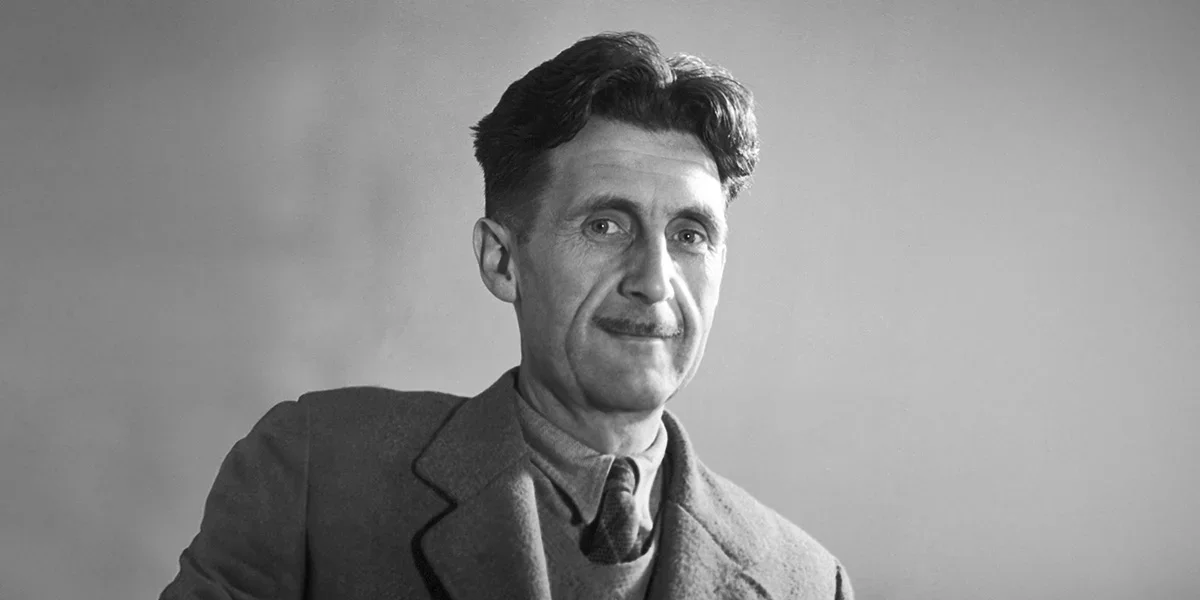
George Orwell: Author, Journalist and Critic
— George Orwell, 1984, Part I, Chapter 3
The above quote is taken from the passage where Winston recalls the Party slogan while thinking about historical falsification and memory.
Orwell’s clairvoyance is manifest. Not so much in the details of the novel, but in the insights it provides in understadning how authoritarian regimes use control of the past as an instrument of power. Here are some examples, taken from the Trump adminstration, ranging from the pathetic and laughable to the deadly dangerous. There is a plethora of examples from other times and places, but the concern here is what happening in our place and our time.
. Early in the Trump administration, officials promoted claims about inauguration crowd sizes that contradicted photograpic evidence . The renaming of military bases, e.g. Fort Bragg in North Carolina, named after a Confederate general, renamed Fort Liberty in 2023, named Fort Bragg again under Trump II. Yet another skirmish in the long-running battle to at last lay the Civil War in its rest-place. . The 1776 Commission (2020), created to counter the 1619 Project, which centers slavery in U.S. history. Its report emphasized “patriotic education,” minimized the role of slavery and racism, and framed civil-rights critiques as divisive. . The disappearance of government websites on environmental and climate data . Trump and allies repeatedly described the Jan. 6 attack as a “peaceful protest,” “legitimate political discourse,” or a false-flag operation. The January 6 attackers who had been convicted in a court of law. . And so on. This is job for historians chroniclers of our current stae of exception.
Language and Clarity
George Orwell’s clearest and most influential statement on the topic of clarity in language appears in his essay Politics and the English Language (Horizon magazine, UK, 1946) The core of his argument is that political corruption and linguistic corruption reinforce one another, and that careless or manipulative language makes unethical politics easier to conduct and harder to resist.
Orwell wrote Politics just after World War II, when propaganda, euphemism, and bureaucratic language were everywhere. The essay is a theoretical prelude to 1984: it explains how corrupted language makes political manipulation and historical rewriting possible.
Orwell’s position can be summarized under several closely connected claims.
Vague language conceals reality Orwell argues that political language is often designed “to make lies sound truthful and murder respectable.” Abstract nouns, euphemisms, and inflated diction allow speakers to describe brutal actions—war, repression, starvation—without forcing either the speaker or the audience to confront their concrete consequences. When language no longer points clearly to reality, moral judgment is dulled.
Bad language encourages bad thinking He insists that sloppy language is not merely a symptom of confused thought but a cause of it. Ready-made phrases, clichés, and stock metaphors allow writers to avoid thinking altogether. Political orthodoxy thrives on this mental automation: if you repeat familiar formulas, you never have to examine whether they are true.
Political language is often defensive by design Orwell notes that modern political speech is typically used to defend the indefensible. Empires, purges, forced population transfers, and torture are all framed in language that sounds technical, neutral, or humanitarian. Precision and plainness would expose the moral stakes, so obscurity becomes a strategic necessity.
Plain language is a moral discipline For Orwell, clarity is not merely stylistic but ethical. Writing plainly forces the writer to ask: What am I actually saying? What facts am I hiding? This self-scrutiny is itself a political act, because it resists manipulation—both of others and of oneself.
Reform is possible Unlike some critics, Orwell believes linguistic decay can be reversed. He offers practical rules—avoid clichés, prefer short words, cut unnecessary words, use the active voice, and never use jargon when an everyday term will do. These are tools for intellectual honesty, not aesthetic purity.
In short, Orwell argues that clear, accurate language is a prerequisite for democratic accountability. When words are precise, lies are harder to tell, power is harder to abuse, and citizens are better equipped to think and also to judge for themselves.