with /claude
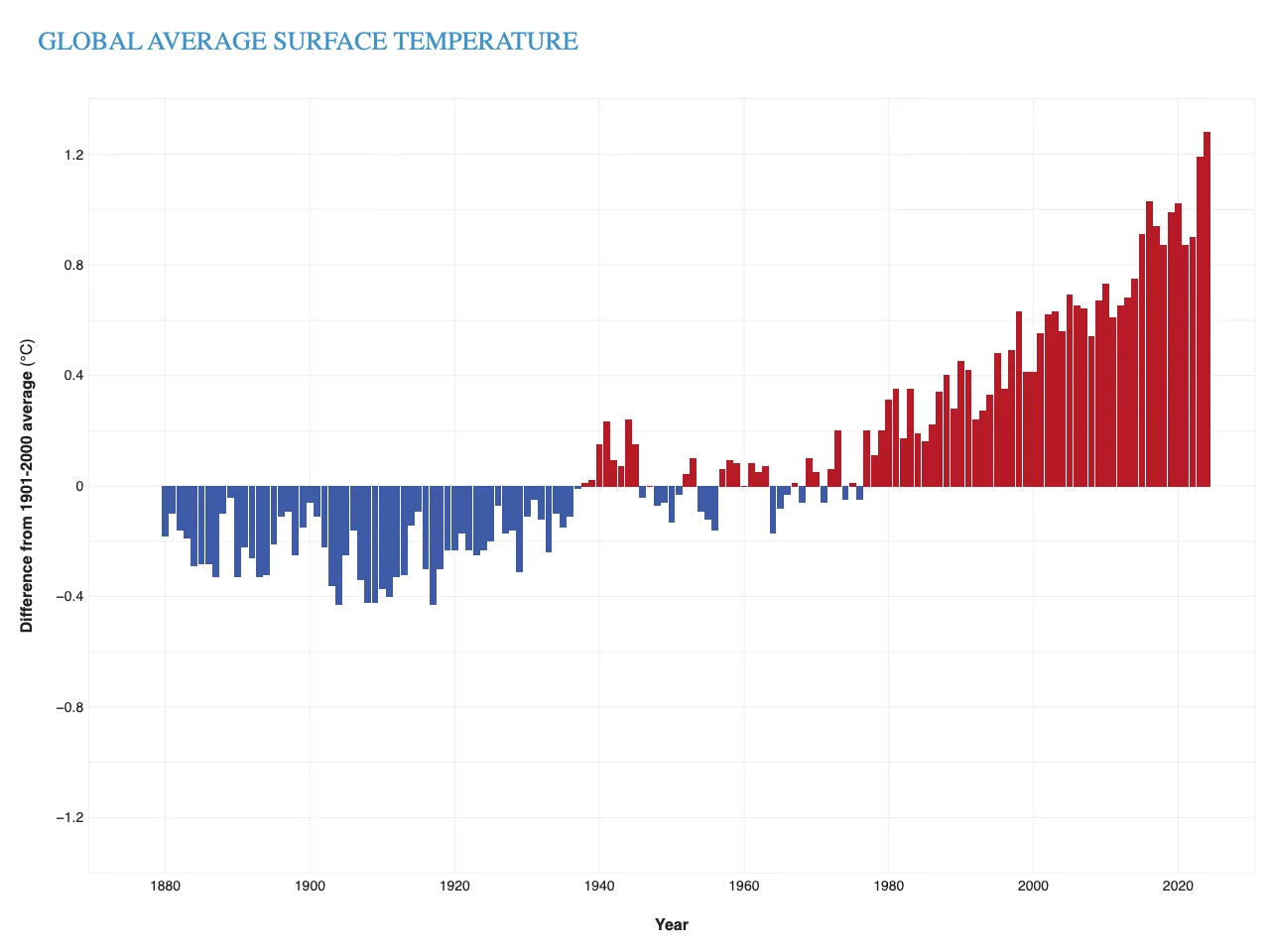
Above is a chart showing how the average temperature of the Earth has changed since 1880. The baseline is the 1901-2001 average.
See NOAA, news | NOAA gistemp | WMO
- Blue bars = years cooler than the 1951-1980 average
- Red bars = years warmer than average
- The black line shows the 10-year moving average, making the warming trend clear
- 2024 was the warmest year on record at +1.29°C above the baseline
The pattern is striking: consistently cooler temperatures in the early industrial period, a gradual shift around the 1970s-80s, and accelerating warming in recent decades.
History
Svante Arrhenius (1859–1927) was a Swedish scientist who made a groundbreaking contribution to our understanding of climate change—he was the first to quantify how carbon dioxide in the atmosphere affects Earth’s temperature.
The 1896 paper. In his landmark 1896 paper, Arrhenius calculated that doubling atmospheric CO₂ would raise global temperatures by about 5–6°C. He worked this out by hand, performing thousands of calculations to model how infrared radiation interacts with CO₂ and water vapor at different latitudes and seasons. His estimate, while on the high end, is remarkably close to modern projections (current estimates suggest 2.5–4°C for a doubling of CO₂).
Prior work. His approach Arrhenius built on earlier work by Joseph Fourier (who proposed the atmosphere traps heat) and John Tyndall (who demonstrated that CO₂ and water vapor absorb infrared radiation). What Arrhenius added was the quantitative framework—he created a mathematical model linking CO₂ concentrations to temperature changes.
An optimistic view. Interestingly, Arrhenius saw potential warming as a good thing. Living in chilly Sweden, he thought a warmer climate might benefit humanity by increasing agricultural productivity and making northern regions more hospitable. He didn’t foresee the pace of industrialization or the negative consequences we now understand.
Legacy. Arrhenius won the 1903 Nobel Prize in Chemistry—not for climate work, but for his theory of electrolytic dissociation (how substances conduct electricity in solution). His climate calculations were largely forgotten until the mid-20th century, when scientists like Guy Callendar and later Charles David Keeling revived interest in atmospheric CO₂ and its effects. Today, Arrhenius is recognized as a pioneer of climate science, having laid the theoretical foundation over 125 years ago.
Prehistory
Earth has experienced several dramatic climate extremes that dwarf anything in human history. Here are some of the most significant:
Snowball Earth (~720–635 million years ago)
During the Cryogenian period, Earth may have frozen almost entirely—ice sheets extending from the poles to the tropics, with average temperatures perhaps as low as -50°C. There were likely two major “Snowball Earth” episodes: the Sturtian (~717–660 mya) and the Marinoan (~650–635 mya).
The trigger was probably a combination of factors: the breakup of the supercontinent Rodinia exposed fresh rock that absorbed CO₂ through weathering, while the lack of land at the poles allowed ice to form easily. Once ice spread far enough, its reflectivity (albedo) created a runaway cooling feedback.
The escape came from volcanoes. With ice covering most of the surface, volcanic CO₂ couldn’t be absorbed by weathering, so it accumulated in the atmosphere until the greenhouse effect overwhelmed the ice’s reflectivity—possibly requiring CO₂ levels 350 times higher than today. The result was an extreme swing from icehouse to hothouse.
The Permian-Triassic Extinction (~252 million years ago)
This was the worst mass extinction in Earth’s history—roughly 90–96% of marine species and 70% of terrestrial vertebrates died. It’s sometimes called “The Great Dying.”
The primary culprit appears to be the Siberian Traps, a massive volcanic province that erupted for roughly a million years. This volcanism released enormous quantities of CO₂ and methane, driving global temperatures up by 8–10°C or more. The warming triggered a cascade of lethal effects: ocean acidification, widespread anoxia (oxygen-depleted “dead zones”), hydrogen sulfide poisoning in the oceans, and ozone depletion from volcanic halogens.
Recovery took 5–10 million years—one of the slowest rebounds from any extinction event.
The Paleocene-Eocene Thermal Maximum (~56 million years ago)
Over a few thousand years, global temperatures spiked by 5–8°C. The cause was a massive release of carbon—possibly from volcanic activity, methane hydrates on the seafloor, or both. CO₂ levels may have reached 2,000+ ppm (compared to ~420 ppm today).
There were no polar ice caps; crocodiles and palm trees existed in the Arctic. Ocean acidification caused widespread extinction of deep-sea foraminifera. Mammals survived and actually diversified during this period, but the event took roughly 200,000 years to fully recover from.
The Late Ordovician Extinction (~445 million years ago)
Paradoxically, this mass extinction (the second-worst ever, killing ~85% of marine species) was caused by rapid cooling and glaciation. A short ice age dropped sea levels dramatically, destroying shallow marine habitats where most life existed. Some researchers think volcanic activity first drew down CO₂ through weathering of fresh basalt, triggering the cooling.
What these events teach us
A few patterns emerge from studying past climate extremes:
- Carbon dioxide has been the master control knob of Earth’s thermostat for billions of years
- Climate systems have tipping points and feedback loops that can amplify small changes into catastrophic shifts
- Recovery from major climate disruptions takes hundreds of thousands to millions of years
- The rate of change matters as much as the magnitude—slow changes allow ecosystems to adapt; rapid changes cause extinctions
The current rate of CO₂ increase is geologically unprecedented—faster than any known natural event, including the volcanic episodes that triggered past extinctions. That’s what makes the present situation so concerning to climate scientists.
Survival
Will we survive the effects of climate change? The best answer is that we don’t know. But to give answers grounded in facts and analysis, we need to be more specific.
Life on Earth will almost certainly survive. Consider the past mass extinctions. Even when almost all life was destroyed, e.g. in Snowball EArth and the Permian Extinction, life survived, recovered, and flourished. But it took time and life after an exctinction event was not the same as life before. Most species went extinct, but from the survivors new forms of life evolved. (Here we are.)
Human life. We as a species will probably survive. But what of our forms of social organization, economic life, and cultural heritage? Our current way of life is sustained by a huge network of people and institutions and interchanges among them. Would this network survive a reduction in population of 90%? 99%? Not likely. We do not have good examples to guide us. But consider the Black Death in Europe (1347–1351). It was one of the deadliest pandemics in human history, killing an estimated 75–200 million people across Eurasia and North Africa—roughly 30–60% of Europe’s population. See Black Death