Twin beams blast from a hidden star in stunning Hubble Space Telescope image | ScienceDaily
#note #tag:science
Science News from research organizations
Hubble unveils a dying star cracking open the dazzling, dust-filled Egg Nebula in a rare cosmic transformation.
Date: February 13, 2026 Source: NASA Summary: A dazzling new Hubble image peels back the layers of the mysterious Egg Nebula, a rare and fleeting phase in a Sun-like starâs death just 1,000 light-years away. Hidden inside a dense cocoon of dust, the dying star blasts twin beams of light through a polar opening, carving glowing lobes and delicate ripples into the surrounding cloud. These striking, symmetrical arcs hint that unseen companion stars may be shaping the spectacle from within. Share: Facebook Twitter Pinterest LinkedIN Email FULL STORY
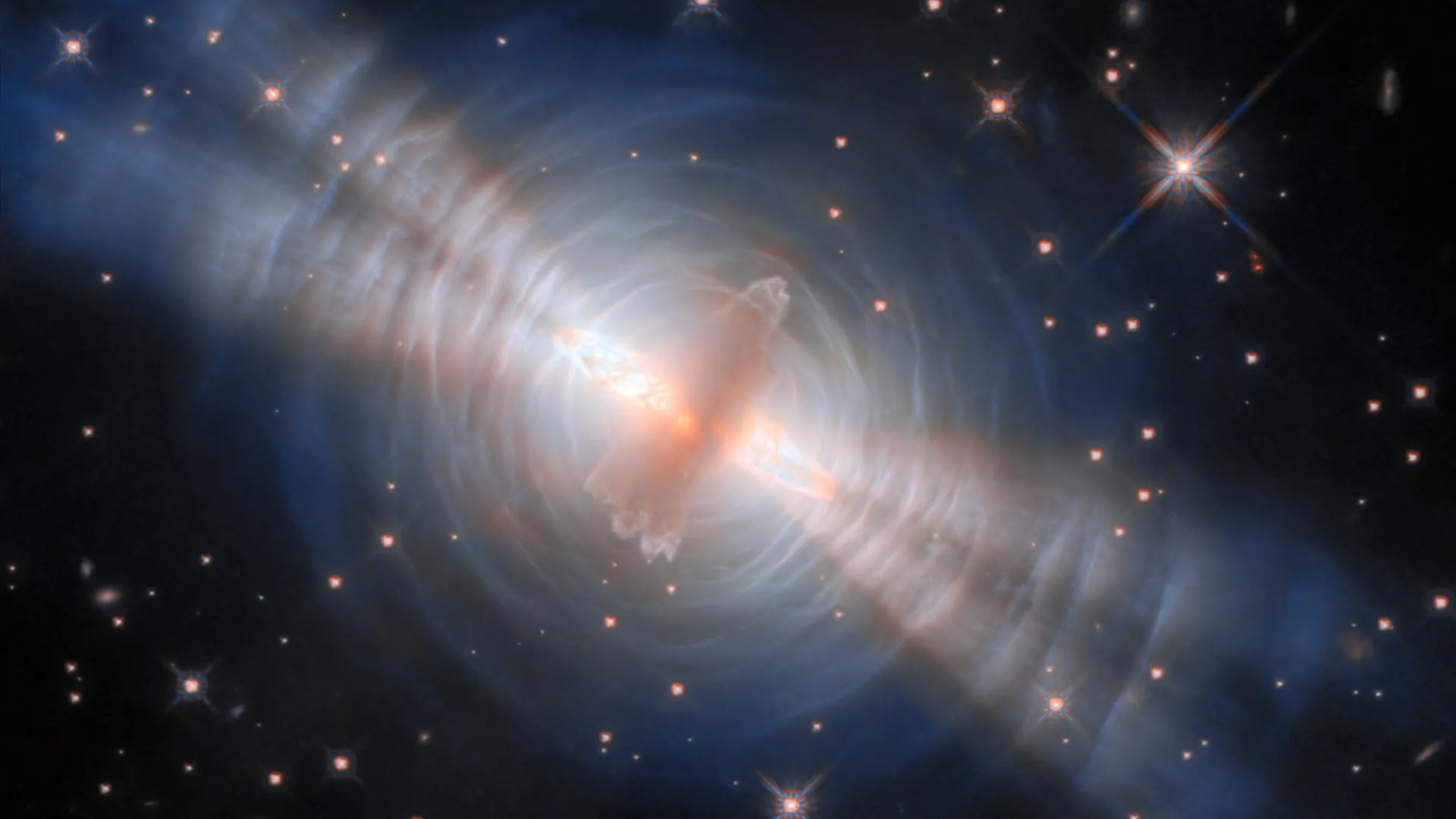
A remarkable new image from NASA’s Hubble Space Telescope highlights a striking mix of brightness and shadow inside the Egg Nebula. This dramatic scene has been shaped by clouds of dust recently expelled by a dying star. About 1,000 light years away in the constellation Cygnus, the nebula surrounds a hidden central star buried within a thick blanket of dust, resembling a glowing “yolk” inside a dark “egg white.” Hubble’s exceptional resolution reveals fine structures that help scientists understand how this unusual object is taking shape.
The Egg Nebula holds a special distinction. It is the first, youngest, and closest pre-planetary nebula ever identified. (A pre-planetary nebula is a precursor stage of a planetary nebula, which is a structure of gas and dust formed from the ejected layers of a dying, Sun-like star. The term is a misnomer, as planetary nebulae are not related to planets.)
A Rare Glimpse of Stellar Evolution
Because it is in such an early phase, the Egg Nebula offers astronomers a valuable chance to study what happens as Sun-like stars approach the end of their lives. At this stage, the nebula shines by reflecting light from its central star. That light escapes through a polar opening, or “eye,” in the surrounding dust. The glow comes from a dusty disk that the star expelled only a few hundred years ago.
Two bright beams stream outward from the star, lighting up fast-moving polar lobes that punch through older, slower rings of material arranged in concentric arcs. The structure and motion of these features point to possible gravitational effects from one or more unseen companion stars, which remain concealed within the dense disk of dust.
From Dying Star to Planetary Nebula
Stars similar to our Sun eventually run out of hydrogen and helium fuel and begin shedding their outer layers. As the hot core becomes exposed, it emits intense radiation that energizes the surrounding gas, producing the glowing shells seen in planetary nebulae such as the Helix, Stingray, and Butterfly nebulae. The Egg Nebula, however, has not yet reached that fully developed stage. It remains in a short-lived transitional period known as the pre-planetary stage, which lasts only a few thousand years. Observing it now allows scientists to examine the ejection process while the evidence is still fresh.
The patterns visible in Hubble’s image are highly symmetrical, ruling out a chaotic explosion like a supernova. Instead, the arcs, lobes, and central dust cloud likely formed through a coordinated series of sputtering outbursts deep within the carbon-rich core of the aging star. Stars at this stage manufacture and release large amounts of dust, material that can later become part of new star systems. Our own solar system, including Earth and the other rocky planets, formed from such recycled material about 4.5 billion years ago.
Hubble’s Continuing Observations
Hubble has studied the Egg Nebula multiple times over the years. An early visible light image from WFPC2 (Wide Field and Planetary Camera 2) was followed in 1997 by a near infrared view from NICMOS (Near Infrared Camera and Multi-Object Spectrometer), offering a closer look at the nebula’s glow. In 2003, the ACS (Advanced Camera for Surveys) revealed the full sweep of dusty ripples surrounding the object. Observations from WFC3 (Wide Field Camera 3) in 2012 zoomed in on the dense central cloud and powerful gas outflows. The newest image combines data from the 2012 program with additional observations, providing the clearest and most detailed portrait yet of this intricate cosmic egg.
For more than 30 years, the Hubble Space Telescope has continued to deliver discoveries that reshape our understanding of the cosmos. The mission is a partnership between NASA and ESA (European Space Agency). NASA’s Goddard Space Flight Center in Greenbelt, Maryland oversees telescope and mission operations, with additional operational support from Lockheed Martin Space in Denver. The Space Telescope Science Institute in Baltimore, operated by the Association of Universities for Research in Astronomy, manages Hubble’s science operations for NASA.
- RELATED TOPICS
- Space & Time
- [i ]Space Exploration
- [i ]NASA
- [i ]Space Telescopes
- [i ]Nebulae
- [i ]Solar Flare
- [i ]Astrophysics
- [i ]Galaxies
- [i ]Sun
- RELATED TERMS
- [i ]Edwin Hubble
- [i ]Astronomy
- [i ]Open cluster
- [i ]Spitzer space telescope
- [i ]Light-year
- [i ]Blue supergiant star
- [i ]Star Trek
[i ]Interstellar medium
Story Source:
Materials provided by NASA. Note: Content may be edited for style and length.
Cite This Page:
- MLA
- APA
- Chicago NASA. “Twin beams blast from a hidden star in stunning Hubble Space Telescope image.” ScienceDaily. ScienceDaily, 13 February 2026. <www.sciencedaily.com/releases/2026/02/260212234205.htm>. NASA. (2026, February 13). Twin beams blast from a hidden star in stunning Hubble Space Telescope image. ScienceDaily. Retrieved February 13, 2026 from www.sciencedaily.com/releases/2026/02/260212234205.htm NASA. “Twin beams blast from a hidden star in stunning Hubble Space Telescope image.” ScienceDaily. www.sciencedaily.com/releases/2026/02/260212234205.htm (accessed February 13, 2026).
Explore More
from ScienceDaily
RELATED STORIES
Betelgeuse Has a Hidden Companion and Hubble Just Caught Its Wake Jan. 10, 2026 Â Astronomers have uncovered the long-hidden cause behind Betelgeuseâs strange behavior: a small companion star carving a visible wake through the giantâs vast atmosphere. Using nearly eight years … A Christmas Tree 80 Light-Years Wide Appears in Space Dec. 25, 2025 Â This Christmas, astronomers are highlighting a spectacular region of space that looks remarkably like a glowing holiday tree. Known as NGC 2264, this distant star-forming region sits about 2,700 … A Hidden Star Found Where Dust Shouldnât Exist Dec. 17, 2025 Â A mysterious cloud of ultra-hot dust around Kappa Tucanae A may finally have an explanation: a hidden companion star. The starâs extreme orbit carries it straight through the dust zone, strongly … Hubble Captures a Wild Star-Birthing Storm 160,000 Light-Years Away Aug. 11, 2025 Â Hubbleâs latest portrait of the Tarantula Nebula reveals a turbulent star-making region far beyond the Milky Way. Located 160,000 light-years away in the Large Magellanic Cloud, this cosmic expanse … Hubble Follows Shadow Play Around Planet-Forming Disk May 4, 2023 Â The young star TW Hydrae is playing ‘shadow puppets’ with scientists observing it with NASA’s Hubble Space Telescope. In 2017, astronomers reported discovering a shadow sweeping across … Hubble Witnesses Shock Wave of Colliding Gases in Running Man Nebula Nov. 24, 2021 Â Mounded, luminous clouds of gas and dust glow in this Hubble image of a Herbig-Haro object known as HH 45. Herbig-Haro objects are a rarely seen type of nebula that occurs when hot gas ejected by a …
TRENDING AT SCITECHDAILY.com
Paleontologists Discover a Lost World: Ancient Cave Preserves Life From 1 Million Years Ago
The Secret to Youthful Skin May Be Hidden in a Microscopic Structure We Share With Pigs
Did a Black Hole Just Explode? Physicists Say It Might Explain Everything